
Vision is much more than just seeing clearly. For children, vision underpins how they learn to move, how they connect with the world around them, and how they develop socially and intellectually. Because so much of early learning depends on what a child can see, even small problems with vision — if undetected — can quietly affect development in ways that are not always obvious.
The encouraging news is that paediatric optometrists can detect and address most visual problems early, often before a child can tell you anything is wrong. Understanding what is normal for your child's age will help you notice potential concerns and seek assessment at the right time.
Vision & Development Milestones That You Might Expect to See By Age
The time frame below outlines what you might expect to see as your child grows. Remember — every child is unique and development occurs across a range.
Birth to 1 month
Your baby only sees in black and white (and shades of grey), so high contrast books can be helpful at this age. Your baby’s vision is also only clear to about 25cm in front of them, so any distance objects will be of no interest to them.
Eye movements in this age category are not well coordinated, and the eyes may appear to wander or be crossed (the eyes themselves are not working together).
However, if one eye appears to be consistently turned in or out, then this warrants assessment by an optometrist experienced in early care.
2 to 3 months
Your baby should start tracking moving objects with their eyes (horizontal more accurate than vertical) and will begin reaching out for things (the very beginnings of eye-hand coordination).
Their visual memory will also be in its primitive stages, to allow the recognition of familiar faces (mum and dad).
4 to 8 months
Your infant’s vision is now improving to better see distance objects, although they will still prefer looking at you closely.
At this age, infants will be using both eyes together and play activities will be further developing their depth perception.
Infants of this age will also have colour perception very similar to that of an adult eye.
9 to 12 months
Infants are becoming more active and will subsequently become better at judging distances and grabbing objects (stereopsis developing); eye movement control is also much improved.
At this stage, object recognition is maturing and infants are performing visually guided hand movements.
Early walkers who did minimal crawling may not learn to use their eyes together as well as babies who crawled a lot.
1 to 2 years
By the age of 2, a child’s eye-hand coordination and depth perception should be well developed.
Children of this age are highly interested in exploring their environment and recognise familiar objects.
Matching games are beginning at this stage, and there is evidence of sustained visual attention.
3 to 6 years
There is significant development occurring through these years. This includes the advancement of matching games (sorting by colour and shape), notable interest in picture books, and improved spatial awareness during play.
The child has significantly improved visual scanning abilities and are producing more detailed drawings. By school age, most children can achieve 20/20 (or 6/6) vision, which is equivalent to that of an adult.
General Developmental Milestones at a Glance
The following milestones — from the Royal Children's Hospital Melbourne — help show the broader picture of child development alongside vision. Vision and general development are deeply interconnected.
| Age | Gross motor skills milestone |
|---|---|
| 3 months | Pushes up on arms when on tummy |
| 6 months | Sits with support |
| 9 months | Stands with support, crawls |
| 12 months | Walks independently |
| 20–30 months | Jumps on the spot |
| 21–36 months | Rides a tricycle |
| Age | Language & communication milestone |
|---|---|
| Birth | Vocalises and cries; startles to sounds |
| 6 weeks | Quiets to parent's voice |
| 4 months | Laughs and squeals |
| 6 months | Babbles; turns to voice |
| 9 months | “Mama” and “dada” non-specifically |
| 12 months | “Mama” and “dada” specifically, plus a few additional words |
| 2 years | Turns pages of books; beginning sentences |
| Age | Social & emotional development milestone |
|---|---|
| Birth | Face regard; recognises caregiver |
| 6 weeks | Smiles responsively |
| 3 months | Smiles spontaneously |
| 6 months | Feeds self; beginning stranger shyness |
| 9 months | Communicates wants without crying; peek-a-boo games |
| 12 months | Waves bye-bye; extends attachment to others |
| 18 months–3 years | Separation anxiety improves; tests boundaries; plays with other children |
| 3–6 years | Enjoys role play; follows rules; can identify happy and sad |
Warning Signs — When to See an Optometrist
The following signs at any age should prompt you to seek an eye examination. Earlier detection almost always leads to better outcomes.
Red Flags in Babies (Birth – 12 Months)
Seek prompt assessment if you notice:
No eye contact or very limited visual engagement by 6 months of age
A white, grey, or cloudy appearance in the pupil (called leukocoria — seek urgent review)
Absence of a red glow in photos taken with flash — one eye appears white or dull Eyes that don't move together, or one eye that turns in or out consistently
Very large, cloudy or unusually small eyes
Drooping of one or both eyelids covering the pupil
Large, slow roving or wobbling eye movements (nystagmus)
Doesn't follow a face or moving toy by 3 months
Red Flags in Toddlers (1 – 3 Years)
One eye that turns in or out, even occasionally
Frequent squinting, screwing up the eyes, or covering one eye
Tilting the head to one side consistently when looking at things
Bumping into objects frequently or unusual difficulty navigating space
Unusual sensitivity to bright light
Holding books or objects very close to the face
Rubbing eyes excessively, or eyes that are persistently red, watery, or sticky
Red Flags in Pre-school & School-Age Children (3 – 6+ Years)
Difficulty matching shapes or pictures on a vision chart
One eye that appears to turn in or out
Closing one eye to look at things
Complaining of headaches or tired eyes, especially after reading or close work
Avoiding reading, drawing, or other near tasks
Losing place when reading; skipping words or lines
Difficulty with hand-eye coordination tasks (catching a ball, colouring within lines)
When Should My Child Have Their Eyes Examined?
Many parents wait until a child starts school — but a paediatric eye examinations can and should happen much earlier. Conditions like amblyopia ('lazy eye'), strabismus (eye turn), and significant refractive errors are best treated during the critical period of visual development (before age 7–8), when the visual system is most adaptable.
| Recommended Timings for Eye Examinations |
| • 6 months of age — first check for eye alignment, early refractive errors, and eye health |
| • 3 years of age — before starting preschool; vision and binocular assessment |
| • 5–6 years — before starting school |
| • Annually once at school, or sooner if any concerns arise |
| • Any time you have a concern — you don't need to wait for a scheduled check |
What Happens at a Children's Eye Examination?
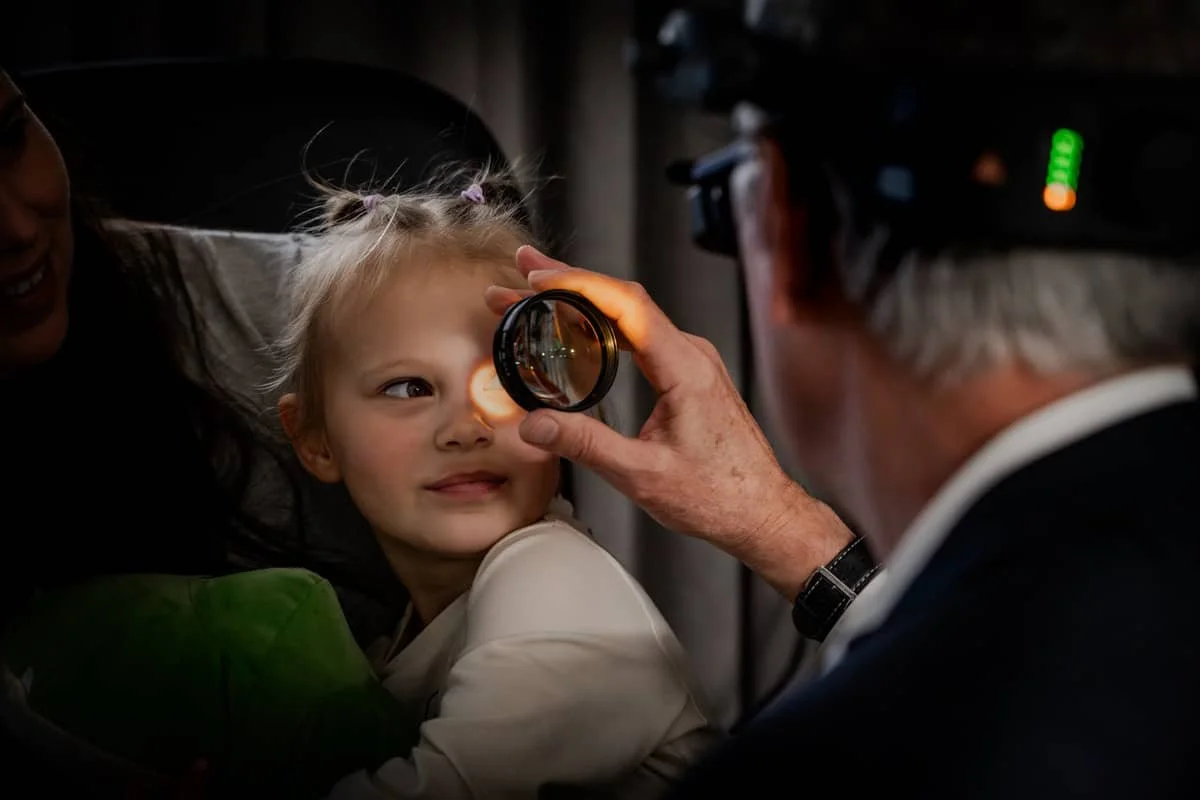
Children's eye examinations are quite different from adult appointments — and a skilled optometrist will tailor the entire experience to your child's age and temperament. A thorough eye health check will be performed irrespective of a child’s age. Here is what you can generally expect:
For babies and very young children, the optometrist will observe how your child focuses and follows moving objects and will use objective instruments (including a technique called retinoscopy) that require no response from your child. A torch test will be used to check eye alignment. Young children may need dilating eye drops to allow a thorough examination.
For toddlers, picture-matching games are used to assess vision — your child simply points to or matches shapes on a card. The examination involves toys, books, and play-based activities to keep your child engaged. Examinations at this age are looking for any large deficits in visual function, and will become more comprehensive as the child gets older.
For pre-school and older children, symbol charts (shapes rather than letters) are introduced, building toward standard letter charts by school age. The examination becomes more comprehensive and may include colour vision and 3D vision (stereopsis) testing. The optometrist will also screen for any significant prescription (i.e. short or long-sightedness), as well as assessment of a child’s focusing and eye aiming abilities. Additional eye movement testing will be performed (link to Right Eye Information) on indication.
| Helpful tip: For children under 4, consider booking a morning appointment after their nap - a well-rested, recently fed child will cooperate much more readily. Let the waiting room experience be calm and reassuring. |
Does My Child Need Glasses?
Not all refractive errors (focusing problems) in young children need to be corrected with glasses — young children can compensate for certain amounts of longsightedness (hyperopia) through their natural focusing ability. However, glasses are recommended when the level of refractive error is high enough to risk amblyopia (reduced vision in one eye), cause a visible eye turn, or significantly affect the child's function.
Your optometrist will use evidence-based guidelines to decide whether glasses are needed, taking into account your child's age, the type and amount of refractive error, the presence of any eye turn, and your child's visual acuity. Refractive errors requiring glasses include short-sightedness (myopia), long-sightedness (hyperopia), and astigmatism.
Your Role as a Parent
You know your child better than anyone. If something doesn't seem right — trust your instincts. Parental concerns are an important part of assessment, and no concern is too small to raise. Early detection and early intervention make an enormous difference to a child's visual development and, through vision, to their overall wellbeing and learning.
Early eye and vision problems in infants can cause marked developmental delays and hence early detection of any issues is paramount. Early intervention ensures that babies have the visual capabilities they need to grow and learn.
If you have any worries about your child's eyes or visual development, contact us and book an appointment. Referrals to other specialists — paediatric ophthalmologists, orthoptists, or allied health professionals — can be arranged when needed.